
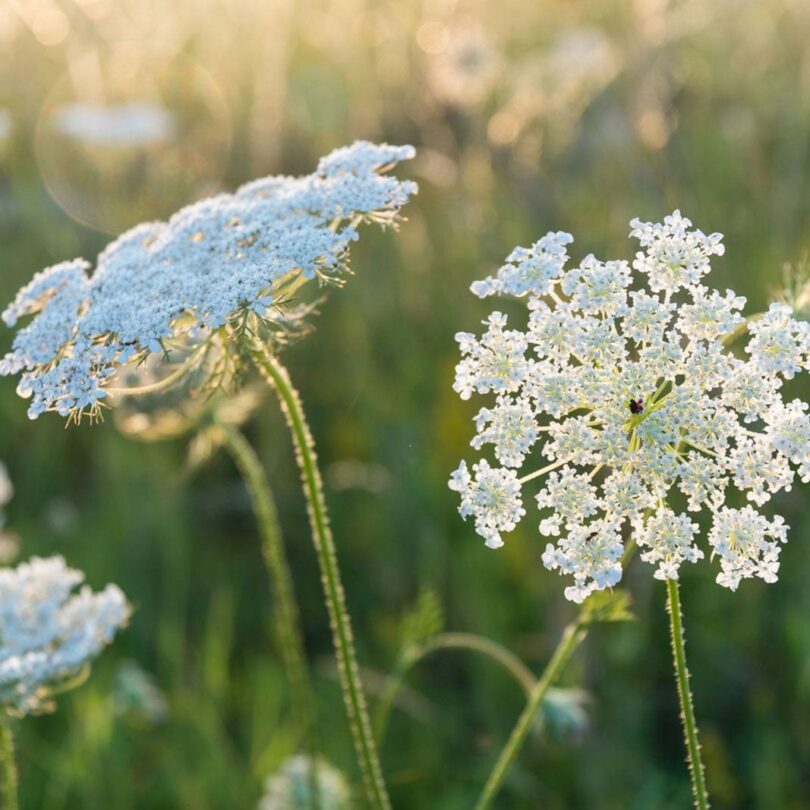

Queen Anne’s lace (Daucus carota) can be seen along the back roads and highways here in Tennessee. She may have originated in Europe but obviously likes it on this side of the pond, especially in the South. Queen Anne’s lace has delicate fernlike foliage and dancing umbels of crisp white flowers. An umbel is a cluster of flowers with stalks of nearly equal length, which spring from about the same point, like the ribs of an umbrella. She also has a tiny little red floret in the center of the bloom. In many ways it is the ideal garden flower. This beautiful flower self- sows and needs no care. I know some of you consider this plant a weed, but it is a versatile long-stemmed flower to me.
The root is edible if you like carrots, but I don’t grow Queen Anne’s lace to eat; it makes a great cut flower. The tiny white cluster blooms blend with almost any flower. I especially like the contrast of Queen Anne’s lace arranged with roses. Its pollen sheds like crazy on the dining room table. Spraying them with hairspray before arranging can slow this shedding. I have also put food coloring in the water and the Queen Ann’s lace will pick up the coloring and change from a creamy white to tints of blue, red, green or the color of your choice.
This plant cannot be found in seed catalogs. Queen Anne’s lace seeds are everywhere free for the taking. Seeds can be collected in late summer or fall as soon as they have dried completely. If you don’t have a friend growing this graceful plant just look for it along the roadside. Cut off the dried seed heads and sprinkle wherever you want this prolific plant next year. You can sow them directly in the garden or any sunny spot. These plants are tough and will survive in poor soil, but they prosper where the earth is loose, fertile, and well drained. Seeds can be planted in either fall or spring. When they first sprout, the new plants look like parsley. They can be either annual (blooming the first year) or biennial (coming up one year then blooming the next). They grow up to 4 feet tall.
All types of insects pollinate the flowers, which may be the reason I remember this regal plant being called ‘chigger weed’ as a child. In fact, I tried to avoid standing by them when out picking blackberries. My brother has a strong aversion to this plant so you can imagine his dismay when arriving for a visit to find Queen Anne’s lace blooming along my driveway. When entering my house, he spotted a large arrangement using its creamy white flowers on the kitchen table. He politely asked me to please take the arrangement outside that “he was itching just looking at them.” I immediately removed the Queen to the outdoors; she looked especially happy sitting on the porch.